
What Andy Burnham Actually Needs to Fix About Work
Can a new Prime Minister be the moment the UK labour market actually gets fixed, rather than just re-narrated?

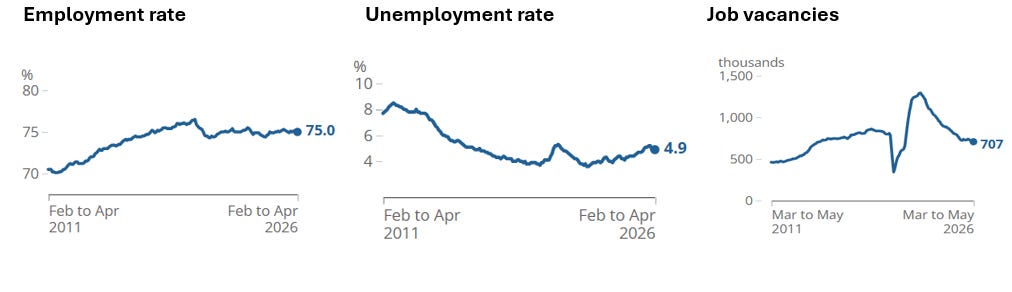
Andy Burnham inherits the job of prime minister at a moment when the UK labour market looks stable on paper - unemployment at 4.9%, employment flat at 75%, vacancies at a five-year low - and is anything but underneath: a million young people NEET, 2.8 million adults out of work through ill health, two decades of stagnant wages. If growth is the priority, then economic inactivity isn't a side issue to it. It's the same conversation. Five fault lines explain that gap between the headline numbers and the reality, and Burnham can't fix any of them by treating them as separate problems.
Figure 1. Employment, unemployment and job vacancies rate of working age population, June 2026
Source: Labour Force Survey from the Office for National Statistics
Credit where it’s due
It would be lazy to wave away the last eighteen months entirely. The Employment Rights Act received royal assent in December 2025, and it is a genuinely significant piece of legislation. From this year, workers get day-one protection from unfair dismissal, day-one rights to paternity and unpaid parental leave, and the removal of the lower earnings limit and waiting period for statutory sick pay. There’s a day-one right to bereavement leave too, and stronger duties on employers around sexual harassment.
That’s not nothing. But the gap between the ambition in Labour’s 2024 manifesto commitment to Make Work Pay and what actually made it into law is wide, and nowhere is that gap more visible than on zero-hours contracts. The commitment to end one-sided flexibility has ended up as a right to “guaranteed hours” after a 12-week reference period.
Parental leave tells a similar story. The promised review is happening, but it’s a cautious one, and it leaves the UK with one of the least generous paternity offers in the EU. And on the economic side, two decisions in particular gave Starmer’s government real political pain: the rise in employer National Insurance contributions, and the increase to youth minimum wage rates.
I’ll be honest, I struggle to see the moral case for paying two people different amounts for the same work based on age alone. The picture on whether the rate rise has actually cost young people jobs is more contested than the headlines suggest, though: the Low Pay Commission and most minimum wage research generally don’t find large employment effects from these increases, but the IFS has flagged that the combined hit from the National Insurance and minimum wage rises fell hardest on the sectors, hospitality and retail, where young people are most concentrated, and payroll data has shown a modest fall in the number of 18-24 year-olds in work over the same period. It’s not a clean story either way, and Burnham will inherit the argument along with the policy.
The five fault lines Burnham inherits
Underneath the day-to-day politics, five structural problems define the UK labour market right now. They’re not new, but they’re all getting worse.
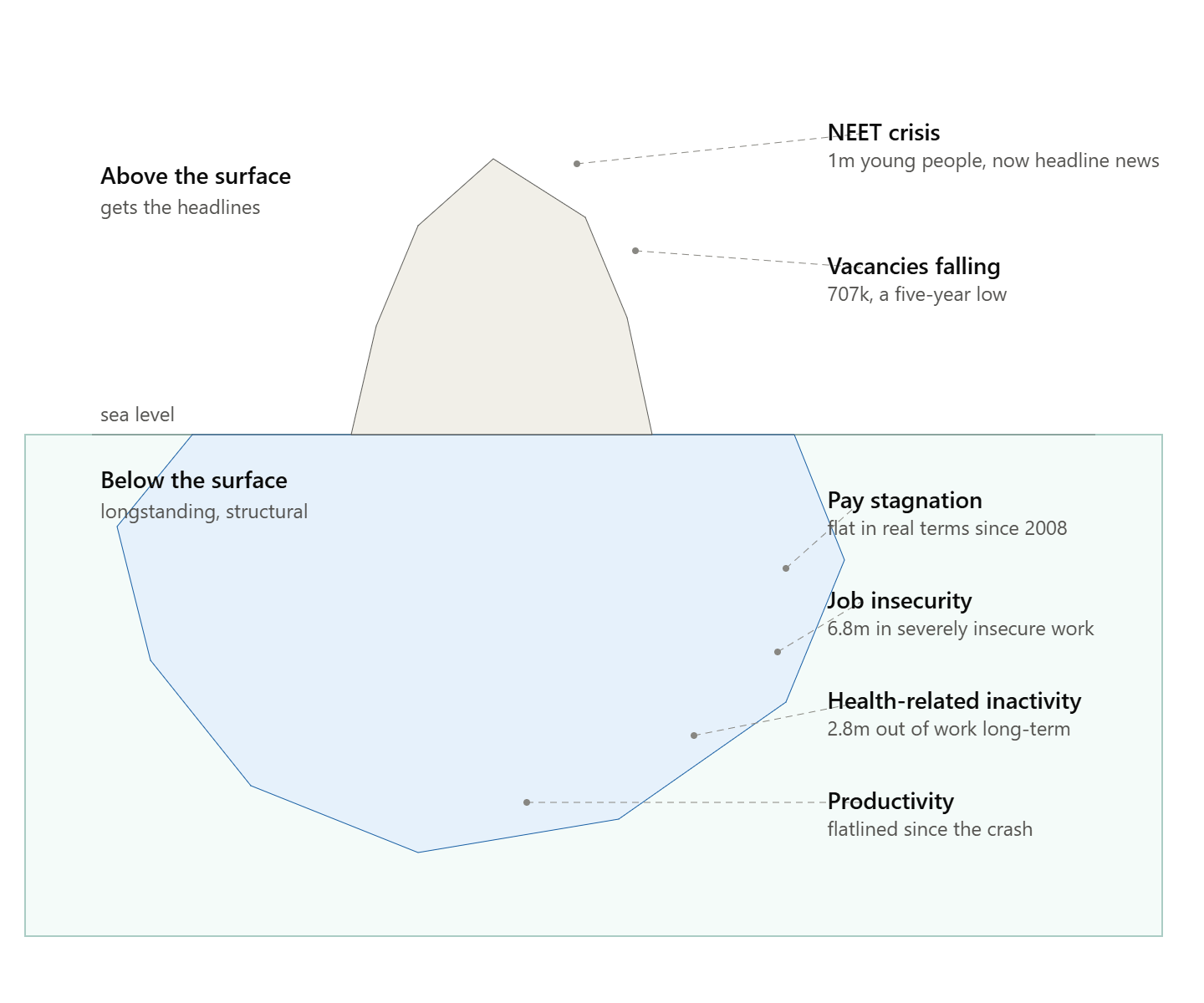
my attempt at visualising five fault lines
1. A NEET crisis that just reached a decade-old ceiling
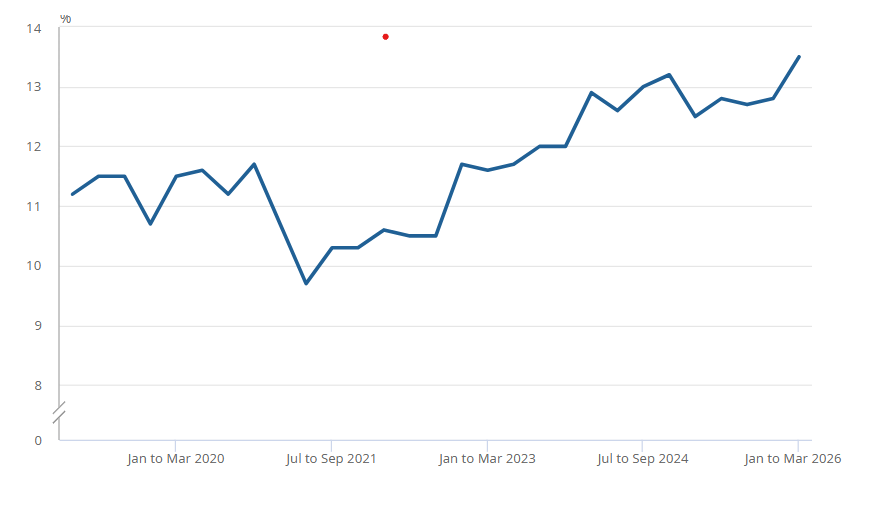
In the first quarter of 2026, the number of 16-24 year-olds not in education, employment or training passed one million for the first time since 2013: 13.5% of the age group, and rising fastest among young men.
Figure 2. People aged 16 to 24 years who are NEET, as a percentage of all people aged 16 to 24 years, by age, seasonally adjusted, UK, January to March 2019 to January to March 2026
Source: Labour Force Survey from the Office for National Statistics
The government’s Milburn review put a number on what this costs: roughly £125 billion a year in aggregate, more than the country spends on education, with a 14-year-old who re-enters a broken youth labour market standing to lose up to £300,000 in lifetime earnings. Six in ten NEET young people today have never had a job at all, up from four in ten in 2005.

The government has responded with a large package. The Jobs Guarantee, offering eligible 18-24 year-olds who’ve been on Universal Credit for 18 months a fully subsidised six-month job at 25 hours a week, is being expanded from an initial 18-21 cohort to cover around 90,000 young people over three years. There’s a £3,000 Youth Jobs Grant for employers who hire a young person who’s been claiming for six months or more, a £2,000 incentive for SMEs taking on 16-24 year-old apprentices. It’s the most focused investment in youth employment in years, and it should be acknowledged as such.
But subsidising an employer to hire someone doesn’t fix the underlying barrier if that barrier is health, not employer reluctance. A youth guarantee only works if it opens doors to genuinely good, flexible jobs with a route upward, not just any placement that gets someone off the statistics, and not a subsidy aimed at people the labour market isn’t currently able to reach at all.
2. Economic inactivity driven by ill health, now at 2.8 million
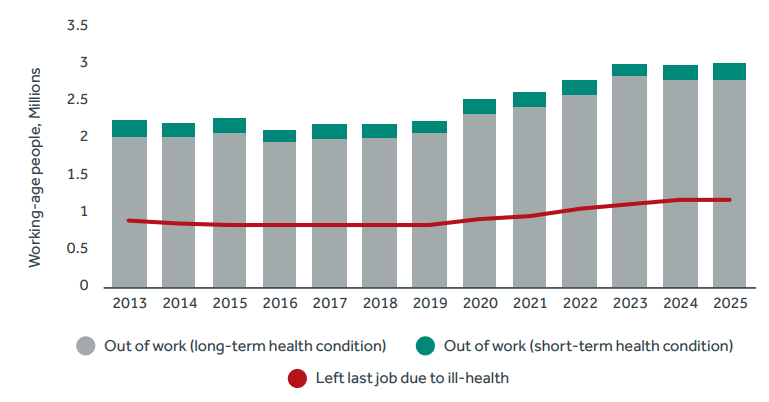
This was the issue everyone was talking about last year, before attention switched to NEET young people, but it hasn’t gone away, and it’s arguably still the bigger structural problem. The government’s Keep Britain Working review found 2.8 million people economically inactive because of a health condition: 800,000 more than in 2019. The disability employment gap sits at nearly 30 percentage points, and without intervention, projections show another 600,000 people could join them by 2030.
There is, at least, a flicker of good news buried in the latest numbers: the pace of increase has more or less stabilised. The chart below shows the trend: a sharp climb through the early 2020s, a peak of 2.84 million at the end of 2023, and a slight easing since, sitting at 2.78 million in the first quarter of this year.
Figure 3. Number of people (16-64) out of work or leaving work due to ill-health in the UK
My own research with colleagues, published in 2025, found that flexibility over core parts of a job is the single strongest determinant of whether someone stays in work after the onset of ill health, and that the first year after someone becomes ill is the critical window: workers with no flexibility at all are four times more likely to leave employment following a health setback than those with meaningful control over how, when or where they work.
These two issues, NEET and health-related inactivity, are the ones that have dominated the last two years of coverage. But there are also longer-standing structural issues in the UK labour market that get less airtime, and Burnham can’t afford to let them slide off the agenda just because they’re less newsworthy.
3. Work doesn’t pay
The Resolution Foundation’s Unsung Britain report, published in February this year, is the most current picture of just how deep this runs. It finds that incomes for the poorer half of working-age households, 13 million families, have grown by just 0.5% a year since the mid-2000s, despite those families working more hours than ever before. In the 40 years before 2004-05, incomes for the same group doubled. At the current pace, a further doubling would take more than 130 years.
That stagnation isn’t evenly spread internationally either. The Foundation’s earlier Ending Stagnation report found that typical UK households are around 9% poorer than their French counterparts, but low-income UK households are 27% poorer than theirs, a gap worth roughly £4,300 a year, so the squeeze has landed hardest on people with the least room to absorb it.
It’s also the underlying reality behind the comparison that made headlines this summer, that UK output per person now barely clears America’s poorest state, Mississippi, and falls below it outside London. It’s a slightly glib shorthand, and the methodology behind these cross-country comparisons is more contestable than the headlines suggest. But the underlying point holds regardless of exactly where the UK sits relative to Mississippi: work in this country has stopped reliably paying enough to live on, which is exactly why so many people are simultaneously employed and reliant on benefits, and why in-work poverty has become as much a feature of the labour market as unemployment ever was.
4. Job insecurity that is both widespread and geographically concentrated
The scale of this depends on which study you look at, and it’s worth setting a few of them side by side. The Work Foundation’s own Insecure Work Index puts the number of UK workers in severely insecure work at 6.8 million in 2023: 21.4% of the workforce, up 600,000 since the previous index.
None of this is randomly distributed. Women are more than twice as likely as men to be affected, disabled workers face a similar gap, and the risk is highest in the South East, North East, Yorkshire and the Humber, and Wales, with Tees Valley the worst-affected local economy, running 4.2 percentage points above the national average.
Insecurity clusters in particular places for structural reasons that go beyond sector mix alone. Weaker transport links that shrink someone’s realistic commuting radius and the jobs they can actually apply for, and the long tail of deindustrialisation, which had a negative impact on mid-skill, secure employment.
This is exactly why any credible growth or devolution strategy has to treat job quality as core infrastructure, not an afterthought, and why Burnham’s devolution agenda and the job insecurity map need to be read as the same problem, not two separate briefs.
5. Productivity that still hasn’t recovered
This is the issue least discussed in public but arguably the one everything else rests on. Without productivity growth, there’s no sustainable route to higher pay, and no fiscal space for the public services a healthier, more secure labour market depends on.
Skills shortages are a big part of why. Skills England’s 2026 annual report found that more than a quarter of job vacancies are now hard to fill specifically because of skills shortages, with particularly stubborn problems in construction, education and manufacturing, and a persistent “missing middle”: a shortfall of people qualified at levels 4 and 5, the technical and vocational tier that sits between school leaver and degree. Private investment in training has fallen by £10.6 billion since 2011, nearly wiping out the value of the government’s entire skills budget. And there’s a sharper edge to this that connects straight back to the NEET crisis. Research from King’s College London has found that firms most exposed to AI have cut junior-level roles by 5.8% and are 16.3 percentage points less likely to post vacancies at all, with UK graduate job adverts down 45% year on year according to Adzuna’s most recent data. The traditional bottom end of the career ladder, the graduate scheme, the entry-level post, the apprenticeship, is exactly where structural change is landing hardest, which makes the skills and productivity problem and the youth unemployment problem two sides of the same coin, not separate items on a to-do list.
What this means for Burnham
These five problems aren’t a checklist to work through in sequence: they are intertwined and they reinforce each other.
Insecure, low-paid work makes people sicker and pushes them toward inactivity. Economic inactivity narrows the tax base and the growth headroom Burnham has promised to expand. A generation of NEET young people who’ve never had a foothold in the labour market becomes tomorrow’s economic inactivity statistic if nothing changes. None of this responds to short-termism, and short-termism is precisely what British politics has specialised in for the past decade and a half.
So, in short:
Burnham needs to make the connection between his devolution agenda and job quality clear. Insecure work is not spread evenly across the country. It is concentrated in exactly the places his “No. 10 North” plan is supposed to help.
He needs to stop treating economic inactivity as only a health-system problem. Workplace design and flexibility are causing at least as much damage. Our own employer research shows the gap is about delivery, not confidence.
He needs a NEET strategy that is judged by the quality of the jobs and training it produces, not by how many young people it removes from the headline number.
The entry-level jobs where people used to build the skills that later make them more productive are exactly the jobs AI is removing first. If the bottom rung of the ladder disappears, it is not only this year’s NEET numbers that get worse. The pipeline of skilled, productive workers the whole growth strategy depends on, ten years from now, gets smaller too.
And above all, he needs to stop managing the labour market quarter by quarter, and instead build the genuinely different approach it now needs.
Because look at what is really happening under these statistics. There is a growing sandwich generation, caring for children and ageing parents at the same time, often while still expected to work full hours in the years when both responsibilities are hardest. People are living longer, but not necessarily healthier. Wages have not grown for two decades, while the jobs that once turned entry-level experience into future earning power are quietly disappearing. Childcare costs are high enough to push parents, mostly mothers, out of the working hours they would otherwise choose.
Whether a change in leadership can bring something genuinely different is still an open question. But it is the right question to ask him, from week one.